

Receiving Webhooks
Everything INFONITE does takes as long as an institution takes. Polling for the moment it finishes means asking a question whose answer is “not yet” almost every time — for every run you have in flight.
A webhook inverts it: you register an HTTPS URL, and we send your backend an HTTP POST the moment something happens. This page is how you set that up. What each product sends you is on its own page, linked at the end.
Two pieces, on purpose
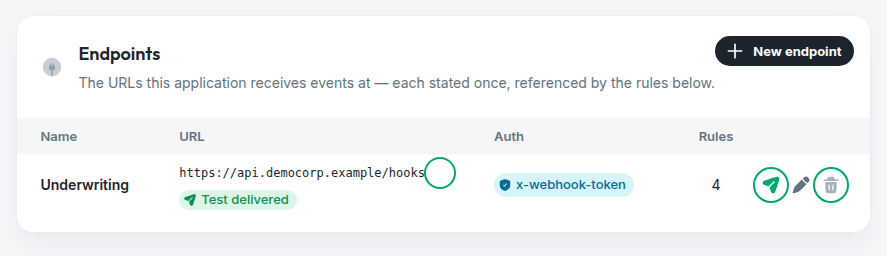
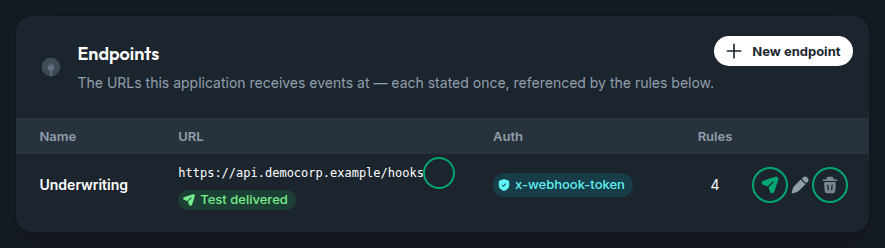
A destination: a name, the HTTPS URL, and optionally one authentication header. Stated once, reused by every event that delivers to it — so rotating a domain is one edit, not six.
A binding: this event goes to that endpoint. One rule per event, each with its own on/off switch — pausing one while you rework a handler never touches the others.
With no rules configured, nothing is delivered — and nothing else changes: polling still works and your executions and sessions run exactly the same. Webhooks are how you stop asking, not a condition for anything to work.
Setting it up
Open your application's settings
Console → your application → App settings → the Webhooks tab. Everything below happens on that one screen: endpoints at the top, rules underneath — and the number beside the tab is how many events are bound right now.
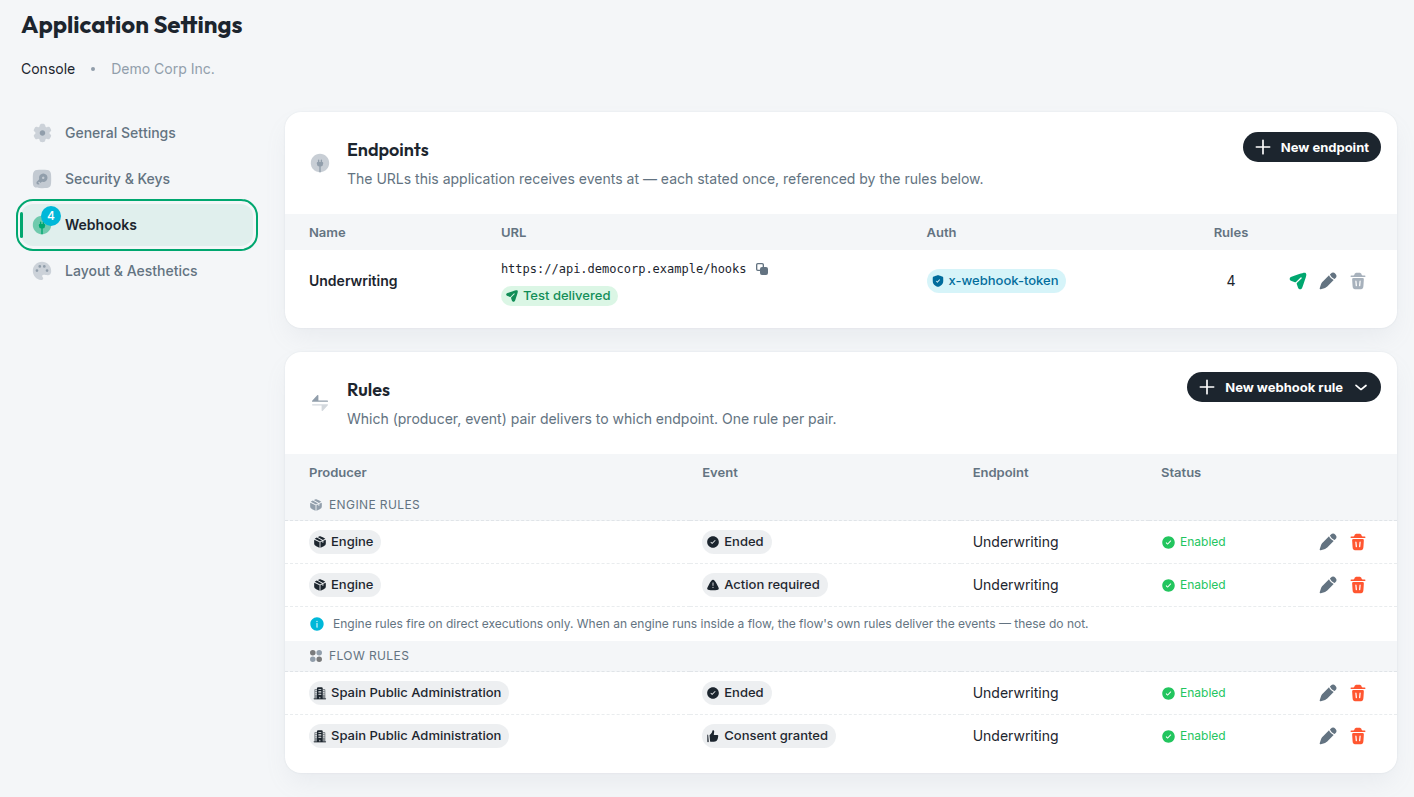
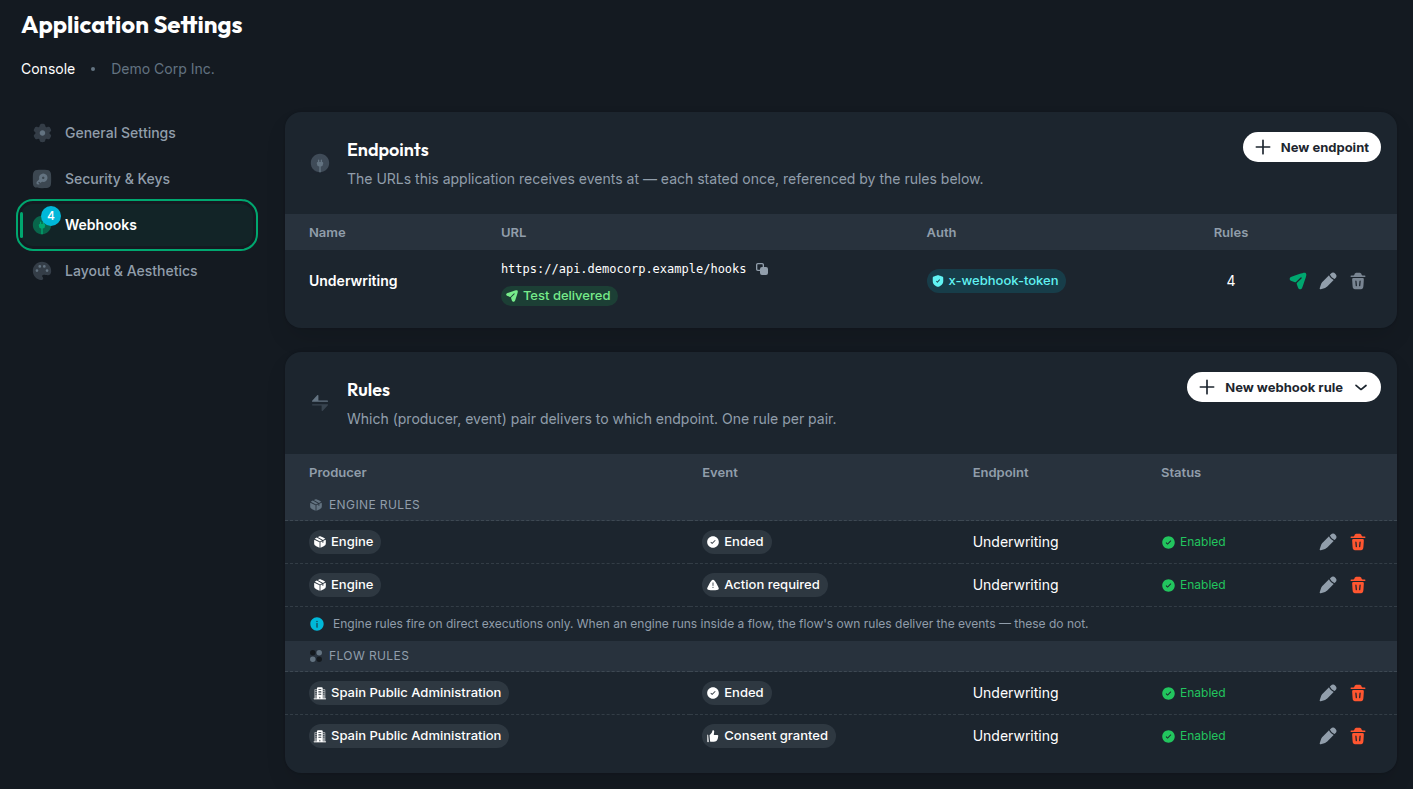
Register an endpoint
New endpoint, then a name (how the rules will refer to it) and the public HTTPS URL. If you add an authentication header, its name is lowercase — authorization or a custom x-… — and its value is write-only: it is stored encrypted and nothing in the platform will ever read it back to you. Keep your own copy when you mint it.
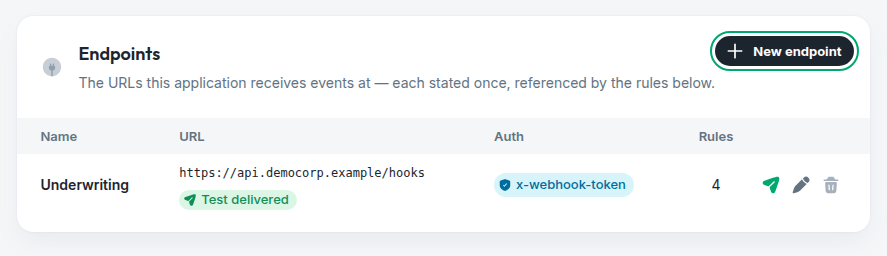
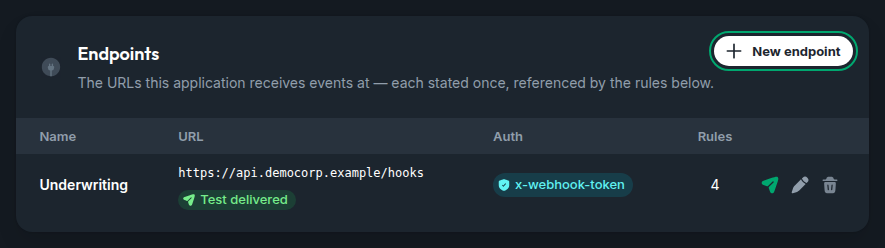
Send a test delivery
Every endpoint has a test action. Use it before you bind anything: it proves the URL resolves, that TLS is valid and that your handler answers 2xx — and it shows you the status we got back. A destination that fails the test will fail every real event.
If the test never arrives, look at your firewall first. Every delivery leaves from a fixed set of addresses, and the Console lists them on this same screen — allow-list them and try again.
Bind the events you want
New webhook rule opens a choice before anything else, and it is the one that matters: an engine rule or a flow rule.
- An engine rule binds an execution event —
started,action_required,auth_ended,ended— and fires on direct executions. - A flow rule binds one flow’s own events, and fires on that flow’s sessions.
Then the event, and the endpoint it delivers to. The table keeps the two families apart for the same reason: they are two vocabularies, not one list. Leave a rule disabled while your handler is not ready — it changes nothing else.
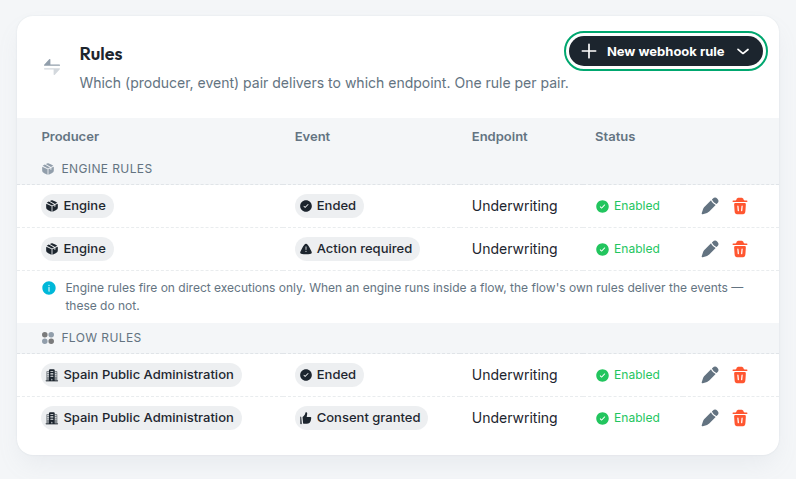
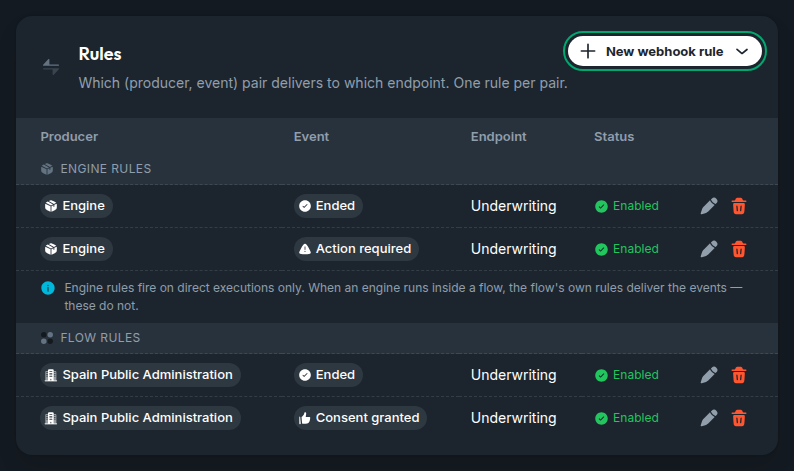
Engine rules fire on direct executions only. When an engine runs inside a flow, the flow’s own rules deliver the events and the engine rules do not — otherwise one journey would notify you twice, from two vocabularies.
The destination URL
HTTPS, to a public host
Plain http, private addresses (10.x, 192.168.x, 172.16-31.x), loopback and link-local ranges, and internal-only names are all refused. A stored destination is fired from inside our platform, so it has to prove it points at the open internet.
No query string of its own
Register https://api.yourcompany.com/webhooks/infonite, not …/infonite?source=x — a query string you store is removed. The query string belongs to the delivery, which fills it in at send time, and a stored one could only collide with it.
Template variables, if you want them in the path
Parts of the URL can be replaced with the event’s own values before the call is made — {customer_id}, {event}, {app_id} and more. The list is per product, because the values are: direct executions, Spain Public Administration.
Authenticating the call
Your endpoint is on the public internet, so it needs to know that a delivery really came from us.
Pick the header
Either authorization or a custom x-… header of your own — x-webhook-token, x-infonite-signature, whatever your gateway already understands. Headers the delivery itself owns (Host, Content-Type) cannot be overridden.
Never put credentials in the URL. A destination like https://user:pass@api.yourcompany.com/hook is refused: it would be stored in clear and shown on every read, which is the opposite of what the encrypted header beside it is for. The same goes for a token in a query parameter.
Where the calls come from
Deliveries leave our platform from a fixed set of addresses. If your endpoint sits behind a firewall that only accepts known sources, allow-list all of them:
The same list is in the Console, on your application’s Webhooks screen, beside the endpoints — that copy is the one to trust if this page and that screen ever disagree, and it is where a change would appear first.
An allow-list is a filter, not an authentication. It proves a request came from INFONITE’s infrastructure — not that it came from your application, and not that the body was not tampered with. Keep the endpoint’s authentication header: the allow-list narrows who can reach you, the header proves who is calling.
Answering a delivery
What each product sends you
Four events about a run: started, a challenge to answer, the login resolved, and the execution finished. They never carry records — the data is read back over an authenticated call.
Four events about a session: opened, consent signed, partial results, and finished. These can carry the records, encrypted, when the session was created with a key.